No. 188 Jinliu Road, High-tech Zone, Jinshan District, Shanghai City, China +86-15001719145 sales@seize-air.com
Follow Us -
Products
Adaptive PM VSD Two-Stage Screw Air Compressor
  • Adaptive PM VSD Two-Stage Screw Air CompressorAdaptive PM VSD Two-Stage Screw Air Compressor
  • Adaptive PM VSD Two-Stage Screw Air CompressorAdaptive PM VSD Two-Stage Screw Air Compressor
  • Adaptive PM VSD Two-Stage Screw Air CompressorAdaptive PM VSD Two-Stage Screw Air Compressor
  • Adaptive PM VSD Two-Stage Screw Air CompressorAdaptive PM VSD Two-Stage Screw Air Compressor
  • Adaptive PM VSD Two-Stage Screw Air CompressorAdaptive PM VSD Two-Stage Screw Air Compressor

Adaptive PM VSD Two-Stage Screw Air Compressor

Adaptive PM VSD Two-Stage Screw Air Compressor from SEIZE AIR combines oil-injected compression with variable-speed control for factory air systems. Select the configuration around demand, pressure and air-quality requirements.

Choose the compressor around the way your factory uses air

A production line rarely uses compressed air in exactly the same way throughout a shift. Tools stop between operations, another process starts, and the compressor continues supplying a shared pipe network. The purchasing decision begins with those changes: how much air the plant needs, where it needs pressure, and what happens when demand falls.

The Adaptive PM VSD Two-Stage Screw Air Compressor is an oil-injected rotary screw system that combines staged compression with a permanent-magnet motor and variable-speed drive. The airend raises pressure through successive compression stages, while speed control helps adjust output as demand changes within the selected machine's operating limits.

This configuration deserves consideration when a factory needs a central compressed-air source and its demand varies. It still requires a suitable air receiver, distribution network and air treatment. Choosing the compressor without examining those parts can leave production with the same pressure or air-quality problem that prompted the purchase.

SEIZE AIR is the brand used by Seize Compressor (Shanghai) Co., Ltd., founded in Shanghai, China, in 2009. This page explains the product architecture, the information needed for selection, and the evidence a buyer should request before placing an order. Specifications belong to the selected model and agreed configuration, rather than to a title alone.

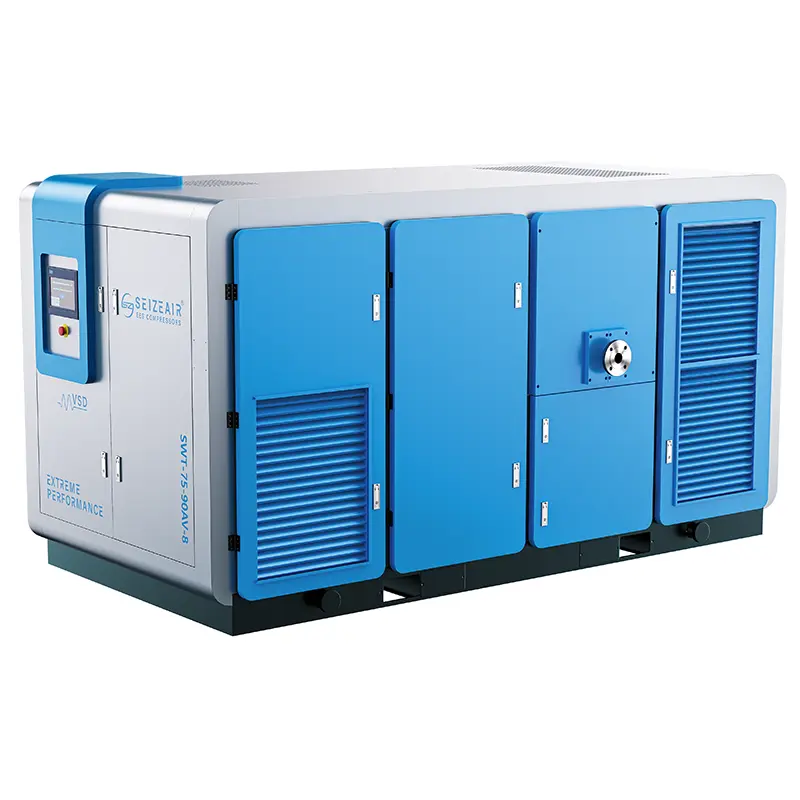
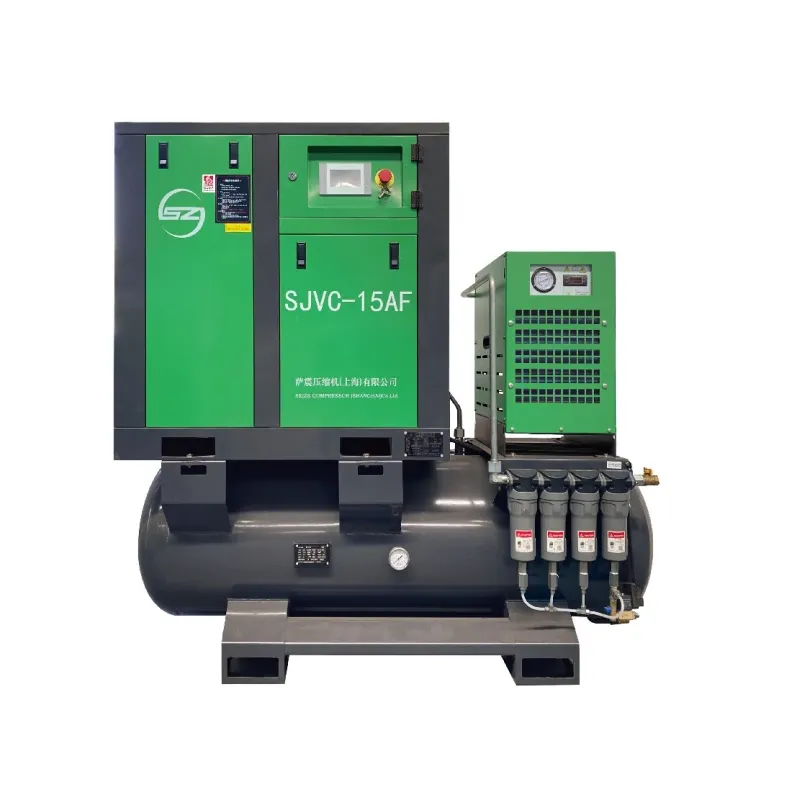
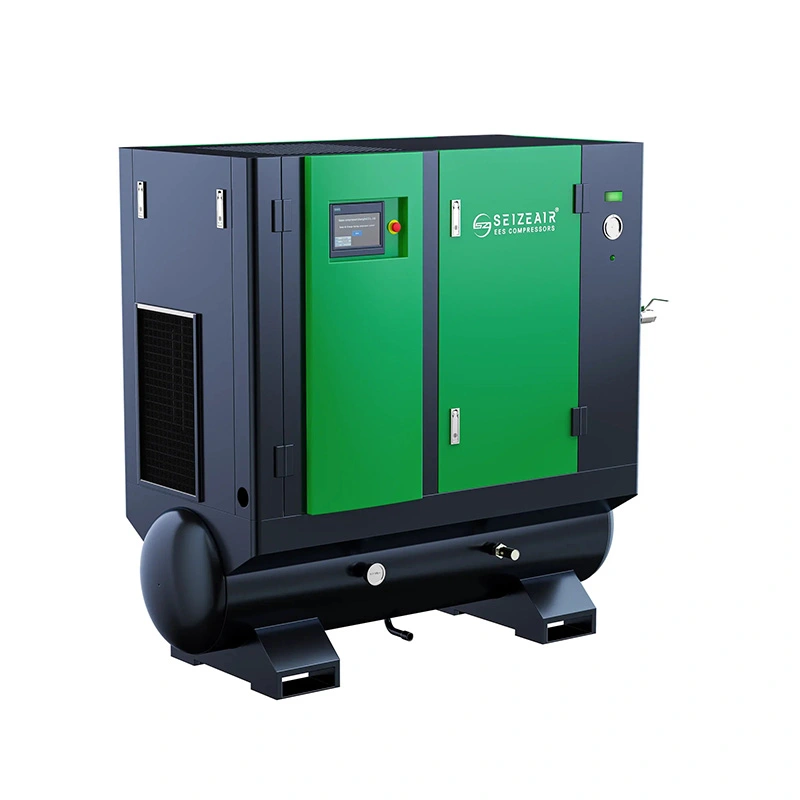
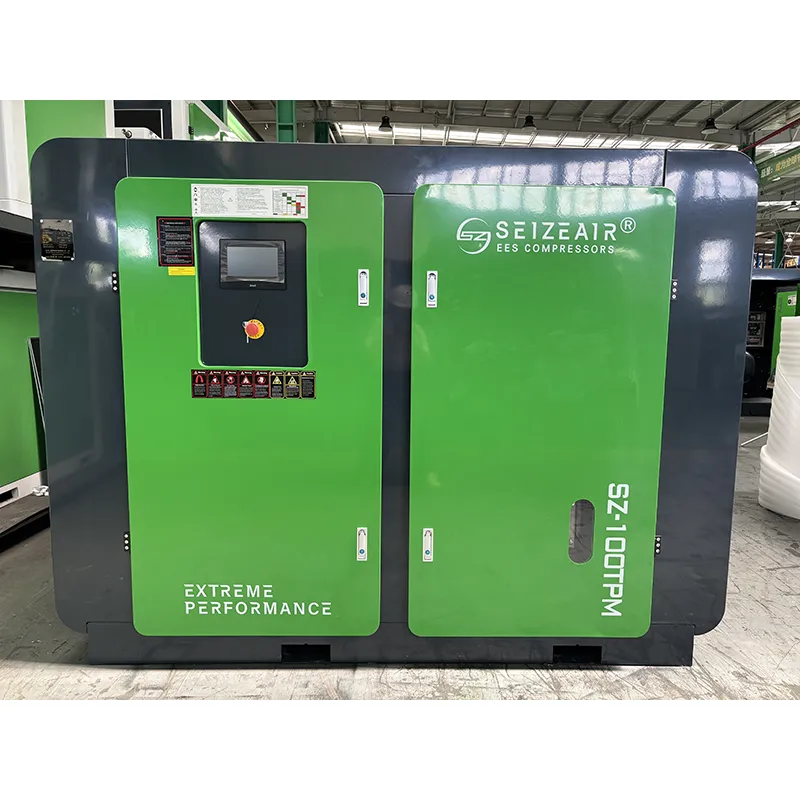
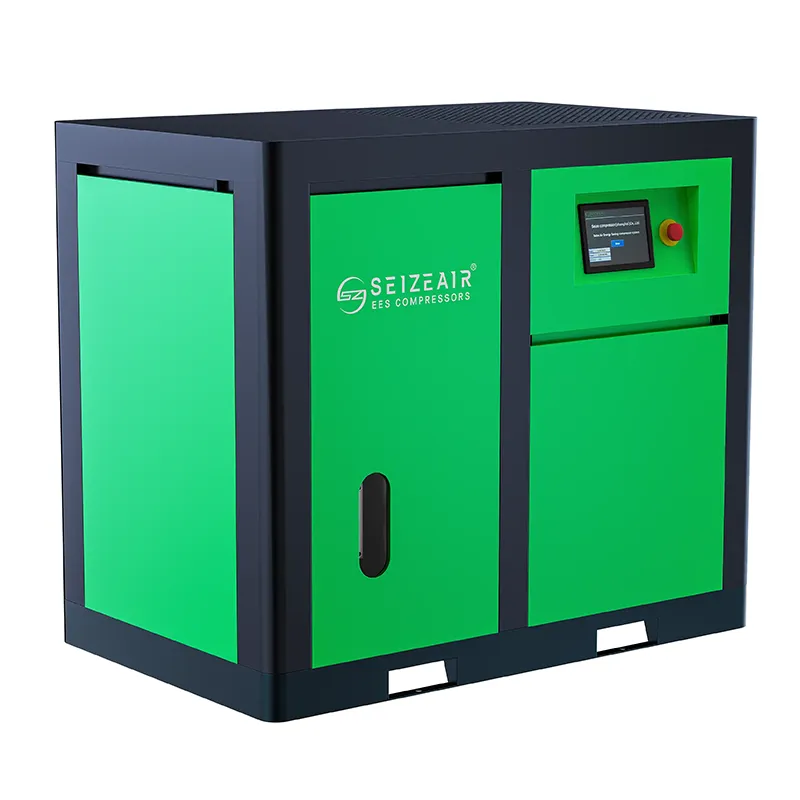
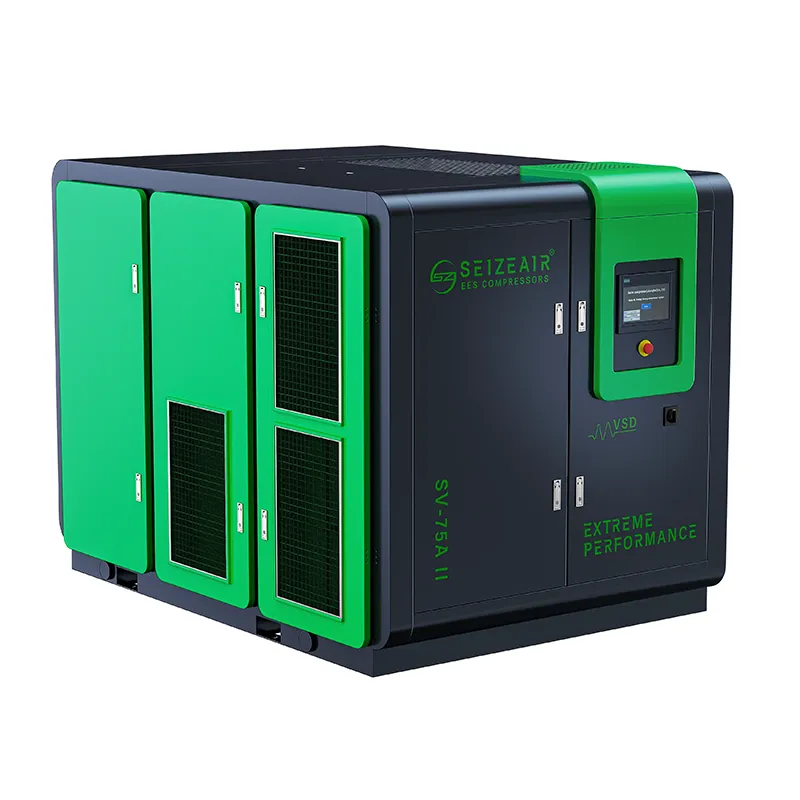
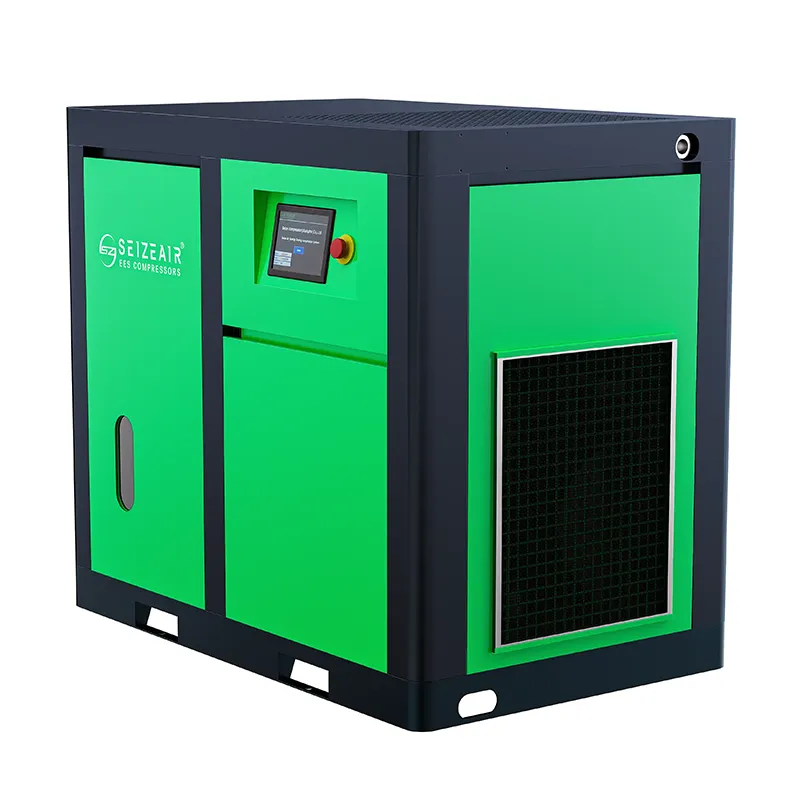
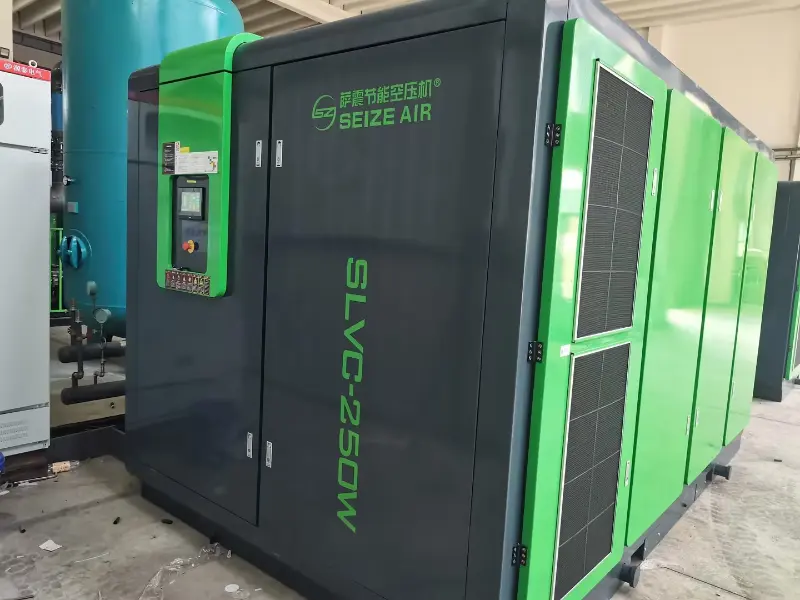
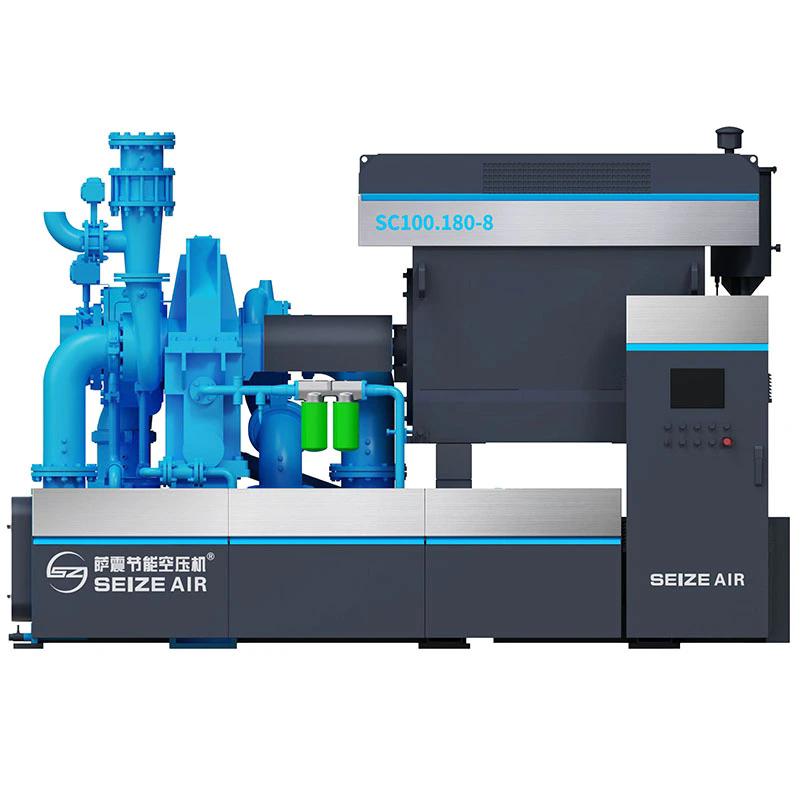
Enclosed SEIZE AIR compressor shown in the two-stage catalogue.

Catalogue product illustration from the English two-stage brochure, October 2025 edition. Appearance and supplied configuration should be checked against the quotation.

What the compressor supplies—and what the air system must add

The compressor produces pressurised air for distribution to equipment. Oil participates in the compression process, providing lubrication, sealing and heat management. The package then separates oil from the compressed air before discharge. That separation does not make the machine an oil-free compressor or establish the air quality at a production machine.

Downstream equipment addresses different requirements. A dryer manages moisture; filters address specified contaminants; an air receiver provides storage and can help accommodate demand changes. The appropriate arrangement depends on the process. Direct product contact, instrument service and general pneumatic tools can require different treatment and verification.

For a shared factory network, identify the most demanding user and the consequences of supplying the wrong air. If a process requires an oil-free compression route, review the dry-type oil-free product category separately. Do not rely on an oil separator description as proof that an oil-injected package satisfies that requirement.

Where this architecture fits

A variable-speed machine can be useful as the unit that follows changes in demand. In a multi-compressor installation, other machines may carry a steadier base load. The division of work depends on the controls, capacity range and required pressure band, so adding another variable-speed unit does not automatically improve the system.

A relatively steady load presents a different purchasing question. The buyer should compare suitable fixed-speed and variable-speed configurations under the actual duty, including their operating costs, maintenance needs and integration requirements. The goal is a machine that runs within an appropriate range, rather than a technology label selected before the load is understood.

How staged compression and speed control do different jobs

Splitting the pressure rise

In a two-stage airend, the first stage raises the incoming air to an intermediate pressure and the second stage raises it further. Dividing the pressure rise changes the work performed by each stage. Heat management between the stages is important because compression increases air temperature.

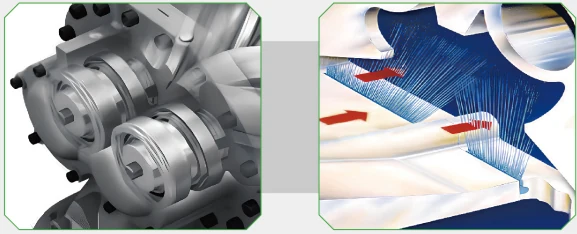
The SEIZE AIR English two-stage catalogue describes a customised two-stage airend, an optimised rotor profile, and lubrication cooling within the airend. These are features of the documented series design. Their presence should be confirmed on the proposed machine, especially when comparing different catalogue editions or a customised configuration.

The engineering reason for reviewing a staged machine is its potential to reduce compression work for an appropriate duty. The result depends on the stage design, losses, operating pressure and actual condition of the package. A brochure explanation of the principle cannot establish an electricity saving for a particular factory.

Following changes in demand

A variable-speed drive adjusts the main motor speed. Within the permitted operating range, that changes the compressor's air output. The permanent-magnet motor and the drive must be considered together with the airend and controller: buying an efficient motor by itself does not establish the performance of the complete compressor.

The catalogue also describes variable-speed control of the cooling fan. Main-motor control and fan control serve different purposes. The main motor follows the compression duty; the fan contributes to thermal management. Buyers should establish whether the proposed configuration includes both, and how its controls respond to the expected operating conditions.

The Adaptive PM VSD Two-Stage Screw Air Compressor should therefore be evaluated as a package. Ask for output and input-power information at the intended pressure, alongside the permitted control range. Comparing nominal motor ratings alone misses losses and auxiliary loads that appear on the factory's electricity bill.

Reading the controls as operating information

The documented controller displays operating information including temperature, pressure and speed. That information helps an operator understand what the package is doing, but it needs context. A rising discharge-pressure reading can coexist with a falling pressure at a remote production machine if the distribution system has excessive losses.

Temperature also deserves a location-specific interpretation. The compressor room, cooling-air inlet and package discharge are different measurement points. A controller reading does not replace checking whether hot exhaust is returning to the intake or whether the cooling surfaces are obstructed.

Ask which readings, alarms and interfaces are available on the offered controller. Establish how those signals will be used by plant personnel or an existing supervisory system. A feature has practical value when somebody can interpret it and take an appropriate action, rather than when it appears as an unused item in a specification list.

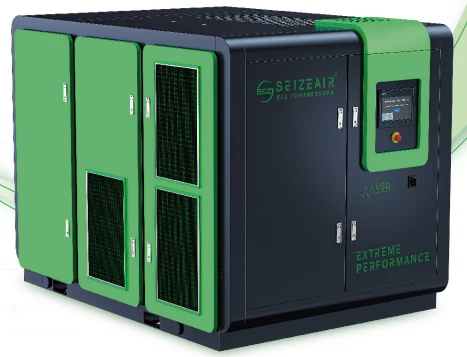
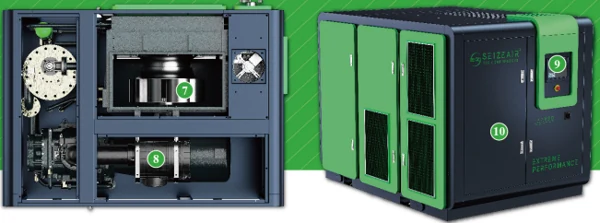
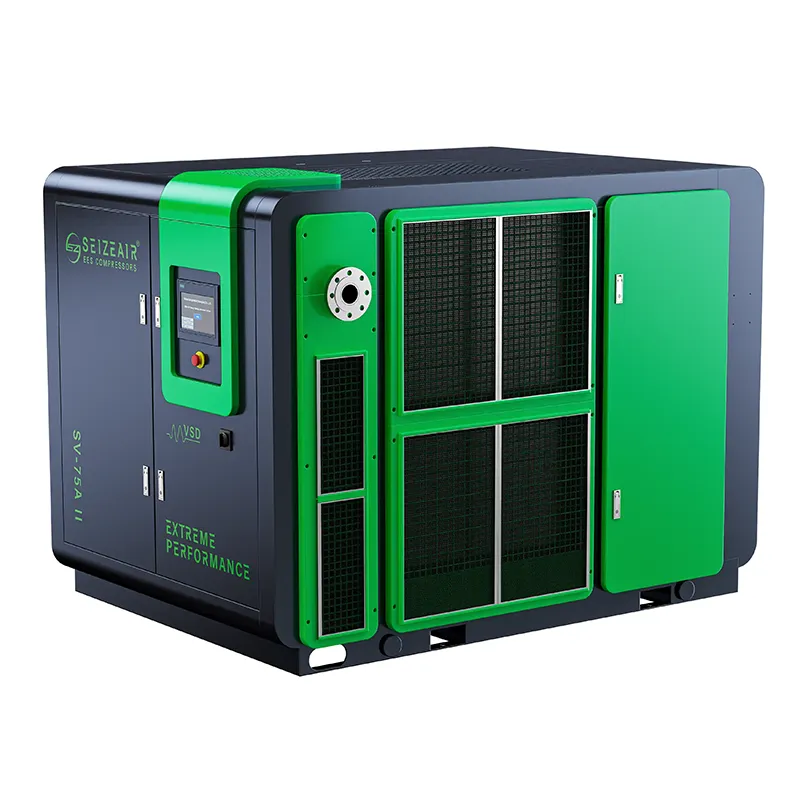
Catalogue illustrations of the package interior and enclosure.

Series illustrations showing an open package and an enclosed package. Numbered markers belong to the source catalogue; they do not identify the configuration of a particular order.

Boundaries that matter in daily operation

Speed control has limits. When demand falls below the selected machine's sustainable output, the controller must manage that condition through its defined operating sequence. Frequent changes around that boundary deserve attention during selection. An oversized machine can spend significant time outside the duty that motivated the variable-speed purchase.

At the other end of the range, production can require more air than a selected machine can deliver. Increasing the pressure setting is not a substitute for sufficient capacity. It can alter power consumption and still leave the remote process short of air during a peak event.

Leaks, unnecessary blow-off and inappropriate pressure settings also affect demand. A new compressor may supply those losses more effectively without removing them. Separate the product purchase from the network improvements, then evaluate how both contribute to the required production outcome.

Specifications: establish the operating point before comparing prices

Documented series range

The October 2025 English brochure identifies the SZ-T/TPM two-stage series with a published range of 20–500 Hp and 4.5–12.5 bar. These are catalogue-level ranges, not a statement that every power and pressure combination is available. The horsepower label should not be rewritten as a kilowatt range.

The table below distinguishes the published scope from information that must be supplied for the selected machine. It is deliberately a purchasing reference rather than an invented model data sheet. A quote becomes comparable when both the machine and the conditions attached to its figures are clear.

Selection item Documented information or required confirmation Why it matters
Compression architecture Oil-injected, two-stage screw configuration described in the series material Determines the compression route and treatment discussion
Main drive Permanent-magnet variable-speed configuration Connects the control strategy to changing demand
Published series power range 20–500 Hp in the October 2025 brochure Establishes the brochure scope; does not identify a model
Published pressure range 4.5–12.5 bar in that brochure Requires confirmation of the offered model and operating point
Delivered airflow Request the selected model's data at the agreed pressure and reference conditions Allows comparison of usable capacity
Package input power Request alongside airflow, including the measurement scope Supports comparison of electrical demand
Electrical supply Confirm voltage, frequency and supply requirements Prevents an unsuitable electrical configuration
Cooling and installation Confirm cooling method, site limits, clearances and heat rejection Connects the package to the compressor room

Airflow figures need a reference

An airflow value is incomplete without knowing what it represents. Capacity may be expressed under specified reference conditions, while a measurement elsewhere in the system reflects local pressure and temperature. Two figures with the same unit can therefore describe different quantities.

When requesting a quotation, state the units used by your existing instruments and provide the reference conditions if available. Ask the supplier to identify how its capacity value is defined. This avoids converting an instrument reading into a purchase requirement using assumptions that neither party has agreed.

The operating pressure belongs beside the airflow value. A capacity figure quoted at a different pressure may not describe the duty your plant needs. Put both on the same comparison sheet before considering purchase price, delivery terms or ancillary equipment.

Power figures describe different things

Motor rated power, shaft power and complete-package electrical input are not interchangeable. The motor rating identifies a component's nominal capability. Package input includes the electrical demand within the defined measurement boundary and is more directly relevant to the plant's supply and operating-cost assessment.

SEIZE AIR's local evidence library includes an SGS-CSTC witnessed performance report dated April 2025 for identified test objects. That report separates nominal information from measured output and input. It illustrates why a buyer should preserve these distinctions, rather than treating a motor label as a complete energy-performance result.

The report was witnessed at the company's internal laboratory and applies to the tested objects. It does not certify this entire product category or every customised order. For your selection, request evidence tied to the quoted model and conditions; the existence of a report for another object is not enough.

Compare a duty, not an isolated efficiency claim

For each suitable offer, place delivered airflow, operating pressure and package input power side by side. Where part-load performance is available, connect it to the plant's demand pattern. A full-load result alone may not represent a machine that will spend much of its operation following variable demand.

Operating-cost estimation also needs the site's tariff and operating schedule. Include the periods during which the machine is running, loaded, unloaded or stopped, as appropriate to the control arrangement. No percentage saving is promised here because those site inputs and a comparable baseline have not been established.

Installation and maintenance can change the comparison. A cooling arrangement that requires major room work or a configuration that lacks suitable local support may carry costs beyond the compressor price. Put those items into the purchasing discussion early, while the proposal can still be adjusted.

Applications: translate the industry name into a process requirement

General manufacturing and pneumatic assembly

In general manufacturing, compressed air can operate tools, actuators and handling equipment. The relevant duty comes from the equipment that operates together, rather than from the number of tools installed. A shared header may see a steady background demand with short additional peaks.

For that pattern, identify which operations need continuous pressure and which can tolerate a brief change. Record the machine sequence during a peak event. This provides a more useful basis for receiver and compressor selection than adding every tool's nominal demand without considering when it operates.

Air quality is a separate requirement. Lubricated tools and a process that exposes a finished surface to air may need different treatment. Confirm the requirements at each point of use before assuming that a common filter arrangement is suitable for the whole factory.

Textile production and other variable factory loads

Textile production can involve compressed-air duties with different timing and sensitivity. A procurement brief should identify the actual machinery and its requirements, rather than using the industry name as proof of compatibility. The same approach applies to packaging, workshop production and automated handling.

If production expands by adding lines, distinguish current demand from the anticipated change. Buying capacity for an uncertain future load can create a poor present operating match. A staged expansion or coordinated multi-machine arrangement may deserve consideration, depending on the available space and control system.

This page does not present a fabricated installation case or claim a result for a customer. Site photographs and project outcomes should only be added when the equipment, location, operating scope and permission to publish have been verified. An application discussion explains selection; a case study must demonstrate a real project.

Pressure complaints: find the point where the loss appears

Observed problem Measurement location Possible explanation Confirmation approach Purchasing implication
Header pressure remains acceptable but a remote machine slows Header and remote machine during the same production event Restrictive distribution path or local treatment Compare simultaneous readings and inspect the affected route Review the network before selecting extra capacity
Pressure falls across the plant during a peak Compressor outlet, receiver and main header Demand exceeds available delivery or controls respond poorly Relate pressure changes to running machines and production sequence Evaluate capacity and coordinated control
Compressor runs while production is stopped Header and controller during the stopped period Leakage, deliberate air use or control settings Identify active users and isolate sections where safe Separate avoidable demand from required production demand
Discharge temperature rises as the room warms Cooling inlet, room and controller Restricted airflow or exhaust recirculation Review airflow paths and the model's installation instructions Confirm room compatibility before placing the order

Separate storage from sustained supply

An air receiver can help serve a short event, but it does not produce air. If consumption remains above compressor delivery, storage will eventually be depleted. The duration and frequency of the event therefore matter as much as the size of the pressure dip.

For a short intermittent event, examine usable storage and the permitted pressure variation. For a sustained increase, assess delivered capacity and control coordination. This distinction can prevent a buyer from requesting a larger receiver to solve an ongoing shortage or replacing a compressor to solve a brief local event.

The installation designer should also review vessel compliance, placement and connected equipment. Receiver selection involves the applicable local rules and the actual system conditions. It cannot be finalised from the compressor product title or a general industry description.

Quality evidence a buyer can use

Manufacturing processes shown in the source material

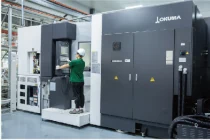
The SEIZE AIR catalogue includes photographs of machining, profile grinding, dynamic-balance inspection and coordinate-measurement equipment. These support a discussion of the documented manufacturing and inspection processes. They do not prove the inspection record of a machine that has not yet been ordered.

For a production order, ask how the selected configuration is identified through assembly and final checks. Model identity, electrical configuration and agreed options should correspond across the quotation, nameplate and delivered documentation. Traceability is useful because it connects a general manufacturing process to a specific piece of equipment.

An inspection photograph should explain what is being examined. A machine-shop image establishes visual context; a dimensional or running-test record provides a different kind of evidence. Buyers benefit from knowing which document answers which question, rather than receiving a collection of unlabelled certificates and pictures.

Machining equipment and dynamic-balance inspection shown in the SEIZE AIR catalogue.

Catalogue photographs of machining and inspection activities. These images are not a claim that the proposed order has already completed its production checks.

Read certification by its scope

A management-system certificate concerns the organisation and activities within its stated scope. A product-compliance document concerns the identified equipment and applicable requirements. An air-quality or performance test concerns the tested object and conditions. These documents should not be treated as interchangeable forms of approval.

Ask for the documents relevant to the destination market and the proposed machine. Check the company name, model or product scope, dates and referenced requirements. Where the buyer has a special process requirement, obtain evidence for that requirement rather than inferring it from a company-level certificate.

Certification for the selected configuration should be confirmed through its applicable documents. A certificate image without a readable scope and validity period is insufficient for procurement. Distinguishing company evidence from model-specific compliance allows the purchasing team to ask for the right documentation before the order is approved.

Dynamic-balance inspection activity pictured in the SEIZE AIR catalogue.

A catalogue photograph labelled as dynamic-balance detection. It provides manufacturing context and is not the test record of an ordered machine.

Establish an acceptance basis before production

A usable acceptance plan states what will be checked and how the results will be interpreted. For a compressor purchase, that can include identification, electrical configuration, operating pressure, delivered airflow and package input power under agreed conditions. The exact checks belong in the agreed order documentation.

If the buyer needs witnessed testing or additional records, raise that requirement before the order is finalised. Availability, method and commercial terms must be confirmed. This page does not promise free sample equipment, a particular test service, or an inspection procedure for every order.

Acceptance also needs to distinguish factory testing from installed performance. Factory evidence describes the machine under its test conditions. The installed system adds room conditions, distribution losses, treatment equipment and process demand. Reviewing both prevents a sound product result from being misread as a guarantee of every point-of-use outcome.

Compare suitable configurations without losing the system context

Two-stage variable speed, single-stage variable speed or fixed speed?

Configuration to review Useful purchasing question Evidence to compare
Two-stage PM variable speed Does staged compression and the permitted modulation range suit the actual duty? Output and package input at the operating pressure, including relevant part-load conditions
Single-stage PM variable speed Is a simpler compression arrangement suitable for the demand and installation? Comparable performance, control range and maintenance requirements
Fixed-speed arrangement Does the plant have a sufficiently steady load or a defined base-load role? Loaded and unloaded operation, sequencing and complete operating cost
Coordinated multi-machine system How should the machines share base load, changing demand and standby duty? Control compatibility, available capacity and response to machine unavailability

The table compares engineering options rather than naming competitors. A two-stage design should earn its place through the duty and evidence. A machine with a simpler architecture may still be a sensible choice for a different load, while an existing compressor may retain a useful base-load role.

What to expect from a manufacturer quotation

When evaluating a China Manufacturer, separate the catalogue description from the binding offer. The quote should identify the selected model, operating point, electrical supply, cooling arrangement and included equipment. Any option that matters to your installation should be written into the configuration rather than assumed from a promotional page.

SEIZE AIR's Shanghai background and documented two-stage product material provide a basis for starting that discussion. The deciding information remains the proposed machine and the terms attached to it. A Factory enquiry becomes productive when it contains a clear duty and requests the evidence needed to compare the response.

Your Supplier comparison should also cover what arrives with the package and what the site must provide. Treatment, receivers, electrical work, ducting and installation services may have different commercial scopes. Clarifying those boundaries prevents apparent price differences from concealing different delivery packages.

Make the delivery scope comparable

Ask each bidder to mark which items are included, optional or supplied by the site. The air receiver, dryer, filters, connecting pipework and control integration can make a substantial difference to the completed installation. Compare a compressor-only price with another compressor-only price, or compare clearly defined system packages.

Use the two-stage product category to review the product family, then request the applicable configuration and scope. Record any exclusions next to the quoted price. This gives the purchasing team and installation team the same understanding of what the order will deliver.

Installation and operating preparation

Plan the cooling-air route

An air-cooled package needs a suitable path for incoming cooling air and outgoing heat. A room can appear spacious while still allowing exhaust to return to the intake. Review the airflow path with the selected machine's installation information, especially where several machines share the same room.

The company's English oil-injected operating manual describes a dry, clean location protected from rain, with attention to ventilation and avoiding hot air from other equipment. That manual is a version-specific reference. Its numerical environmental limits should not be transferred to every current model without confirming the applicable instructions.

Before ordering, provide the intended location, cooling arrangement and known ambient conditions. Establish which room work is required and who designs it. The machine should be selected together with its installation conditions, rather than delivered first and fitted into whatever space happens to remain.

Leave room to maintain the package

Access is part of the installation design. Service personnel need to reach the relevant panels, consumables and components and move replacement parts safely. The exact clearances come from the selected model's instructions. A photograph of the enclosure cannot define the space needed around it.

Consider the route into the building as well as the final position. Doors, handling equipment and the floor arrangement affect delivery and maintenance. Confirm dimensions, mass and lifting information from the actual configuration before organising transport or deciding that the existing compressor position can be reused.

The package's intake also needs attention. Dust and other contaminants can increase the burden on filters and cooling surfaces. Identify the source of contamination and review the appropriate location and maintenance plan. A larger compressor does not compensate for an unsuitable intake environment.

Airend and interstage-cooling illustrations from the two-stage catalogue.

Catalogue engineering illustrations of rotor features and interstage cooling. These are explanatory graphics, not an inspection photograph or a measured temperature result.

Connect electrical and operating responsibilities

Electrical integration requires the supply characteristics and the selected package's requirements to be reconciled. A variable-speed drive is part of an electrical system, so installation should follow the applicable instructions and local requirements. Qualified personnel should establish the protective and isolation arrangements appropriate to the installation.

Plant operators also need to know how the new machine will interact with existing equipment. Define which controller establishes the pressure target, how machines are sequenced and how alarms are handled. Different machines responding independently to overlapping pressure settings can produce an operating pattern that was not intended during selection.

Keep the configuration record with the operating documentation. It provides the reference for future parts enquiries, control changes and maintenance decisions. This is particularly useful where the purchaser, installer and plant operator are different organisations with different responsibilities.

Prepare for commissioning without inventing service promises

Commissioning should connect the installed machine to the agreed duty. Review the installation, run the relevant operating checks and establish initial records for pressure, temperature, control behaviour and air treatment. The procedure and responsible parties must be confirmed for the order and destination.

Training should explain normal operation, alarm interpretation, shutdown and the applicable maintenance instructions. It should also identify when an operator must stop and seek qualified support. General online material can assist understanding, but it does not replace the selected machine's manual or site-specific instructions.

Warranty duration, response time, local attendance and spare-parts arrangements are commercial commitments. They should be established in writing for the destination and contract. No domestic service promise or unverified warranty period is presented here as a worldwide offer.

Questions buyers ask before selecting a machine

Can this machine replace an existing compressor without changing the air system?

Possibly, but the existing system still needs to be assessed. Confirm delivery at the required pressure, electrical compatibility, cooling, connections and air treatment. If the original problem comes from restrictive pipework, inadequate treatment or avoidable demand, replacing the compressor alone may leave that problem in place.

Is the advertised power range enough to choose a model?

No. The brochure range identifies the series scope. Model selection requires the operating pressure, required airflow, duty pattern and installation conditions. Ask for a model-specific proposal with its measurement conditions and configuration, then compare that proposal with the same requirements used for other suitable offers.

Can an oil-injected machine supply air for a sensitive process?

The answer depends on the process's air-quality requirement and the complete treatment system. State the required quality at the point of use, including whether oil-free compression itself is specified. Do not equate a separator efficiency claim or a downstream filter with evidence that every sensitive application is suitable.

Does variable speed guarantee a lower electricity bill?

No. The result depends on the demand profile, permitted operating range, pressure setting, system losses and comparison baseline. A properly matched configuration can be evaluated using relevant output and input-power data. The site's operating schedule and tariff are needed to translate that assessment into an operating-cost estimate.

Should the machine be deliberately oversized for future production?

Future demand should be included, but separate confirmed expansion from uncertain plans. Oversizing can create a poor match to the present load. Compare expansion options, sequencing and standby needs before deciding how much capacity to install now and what can be added later.

What is the difference between a series brochure and a test report?

A brochure describes the product family and its published features or scope. A test report records results for identified objects under stated conditions. Neither should be used outside its limits. Ask for evidence that connects the quoted model and operating point to the performance claim important to your purchase.

Can I ask for a customised electrical or control configuration?

Describe the required supply, interface and operating arrangement in the enquiry. The manufacturer must confirm whether the requested configuration is available and what it changes. Customisation should be documented in the quotation; this page does not assume that every voltage, controller or interface can be supplied.

What should an overseas buyer confirm about delivery and support?

Confirm the delivery scope, destination requirements, documentation, packing, handling and service responsibilities in the contract. Establish which local work and commissioning activities are included. Warranty, returns and technical-support terms need written confirmation for the order rather than a general promise copied from a different market.

Which information will make the first enquiry useful?

Send the required pressure at the production equipment, the known airflow and its reference conditions, the pattern of operation, and the required air quality. Add the electrical supply, installation location and existing compressor arrangement. If measurements are unavailable, describe the process and identify what remains unknown.

For an Adaptive PM VSD Two-Stage Screw Air Compressor enquiry, those inputs allow the proposed machine to be assessed against a real duty. Use the SEIZE AIR contact page to request a model-specific configuration and supporting performance information. Confirm the final proposal before procurement, including installation scope and destination-specific service terms.

Send Inquiry
Contact Info
For inquiries about Oil-Injected Screw Air Compressor, Oil-Free Screw Air Compressors, Gear-Type Centrifugal Air Compressor or price list, please leave your email to us and we will be in touch within 24 hours.
X
We use cookies to offer you a better browsing experience, analyze site traffic and personalize content. By using this site, you agree to our use of cookies. Privacy Policy
RejectAccept